// MAJIC TAKEOFF · DEFENSIBLE BID TAKEOFFS, LINE BY LINE
Takeoffs you can defend. Bids you can stand behind.
Majic Takeoff converts construction drawings and specs into a defensible, line-item bid takeoff — every device located, every count verified, every number traceable. It cross-checks what it counts against the engineer's own schedules and specs, and where the documents genuinely don't say, it quotes the gap as a clearly-marked allowance rather than inventing a number. You get a bid you can put your name on.
What it produces
A defensible, line-item bid takeoff from your drawings
How counts hold up
Corroborated across independent readings, not a single pass
When docs are silent
Quoted as a clear allowance — never a guess
How you bid
Combined and per-trade, ready to send
The problem
Manual takeoffs waste time, introduce errors, and often miss critical scope details
Counting devices by hand across dozens of sheets is the least glamorous, highest-stakes part of a bid. One missed schedule, one sheet skimmed too fast, and the number that goes out the door is wrong — and you don't find out until it's a change order or a loss.
Slow
Days per package, not hours
Highlighting plans and tallying counts eats the estimator's week. The bigger the set, the later the nights — and the more bids you have to walk away from simply because there wasn't time.
Error-prone
One tired pass, one wrong number
A single human read of a busy drawing set will miss things. A double-count here, a skipped riser there, and the total is off — with nothing to show a reviewer how it was reached.
Missed scope
The devices you never saw
The most expensive mistakes are the ones off your radar — a schedule on a sheet you didn't open, a spec section that adds scope the plans imply but never draw. Zeros that should not be zeros.
How Majic Takeoff helps
Multi-source verification, not a single pass
Majic Takeoff doesn't just read a drawing once and hand you a number. It reads your documents independently, several ways over, then reconciles those readings against each other and against the engineer's own device schedules and written specifications. A count only becomes firm when the sources agree. Where they can't — because the documents genuinely don't say — the line is quoted as a marked allowance and surfaced for your review. Nothing is invented, and every number traces back to something in your set.
Your drawings & specs, in full
Hand over the plan set and specifications as issued. No prep, no re-drawing, no tagging things by hand first.
Every device located
Devices are found and counted across the whole set — not one sheet in isolation, but the drawings read together as the coordinated package they are.
Cross-checked against the record
Counts are reconciled against the engineer's own device schedules and the written specs. Agreement makes a count firm; a conflict gets flagged instead of buried.
A takeoff you can defend
Out comes a line-item takeoff with firm counts, marked allowances, and a source trail behind each number — ready to price and send.
What sets it apart
Built for numbers you'll have to defend in a room
A bid is a promise with a price on it. These are the things that let you make that promise with a straight face.
Counts corroborated across sources
Every count is checked more than one way and reconciled against the engineer's schedules and specs. When the sources agree, the number is firm. You're not trusting a single read — you're trusting the places they line up.
Unknowns become allowances, never guesses
Where the documents genuinely don't say, Majic Takeoff won't quietly make up a number. It quotes the gap as a clearly-marked allowance and puts it in front of you, so a blank on the plans never turns into a silent hole in the bid.
Every line traces back to your set
Each number carries a trail back to the sheet, schedule, or spec it came from. When a GC or a reviewer asks "where does this come from?", the answer is right there — line by line, defensible on the spot.
Combined and per-trade bids
Get one combined number and clean per-trade packages from the same takeoff. Bid the whole scope, or split it out by package to match how the job is actually being let — without recounting anything.
Addenda & revision tracking
Drawings change mid-bid. Feed in the revised set or an addendum and see exactly what moved — which counts went up, which went down, and what's new — so your number keeps pace with the documents instead of falling behind them.
Turnaround measured in hours
The count that used to swallow days comes back the same day on most packages — which means you can chase bids you'd otherwise have had to let walk right past.
Firm vs allowance
You always know which numbers are solid — and which need a look
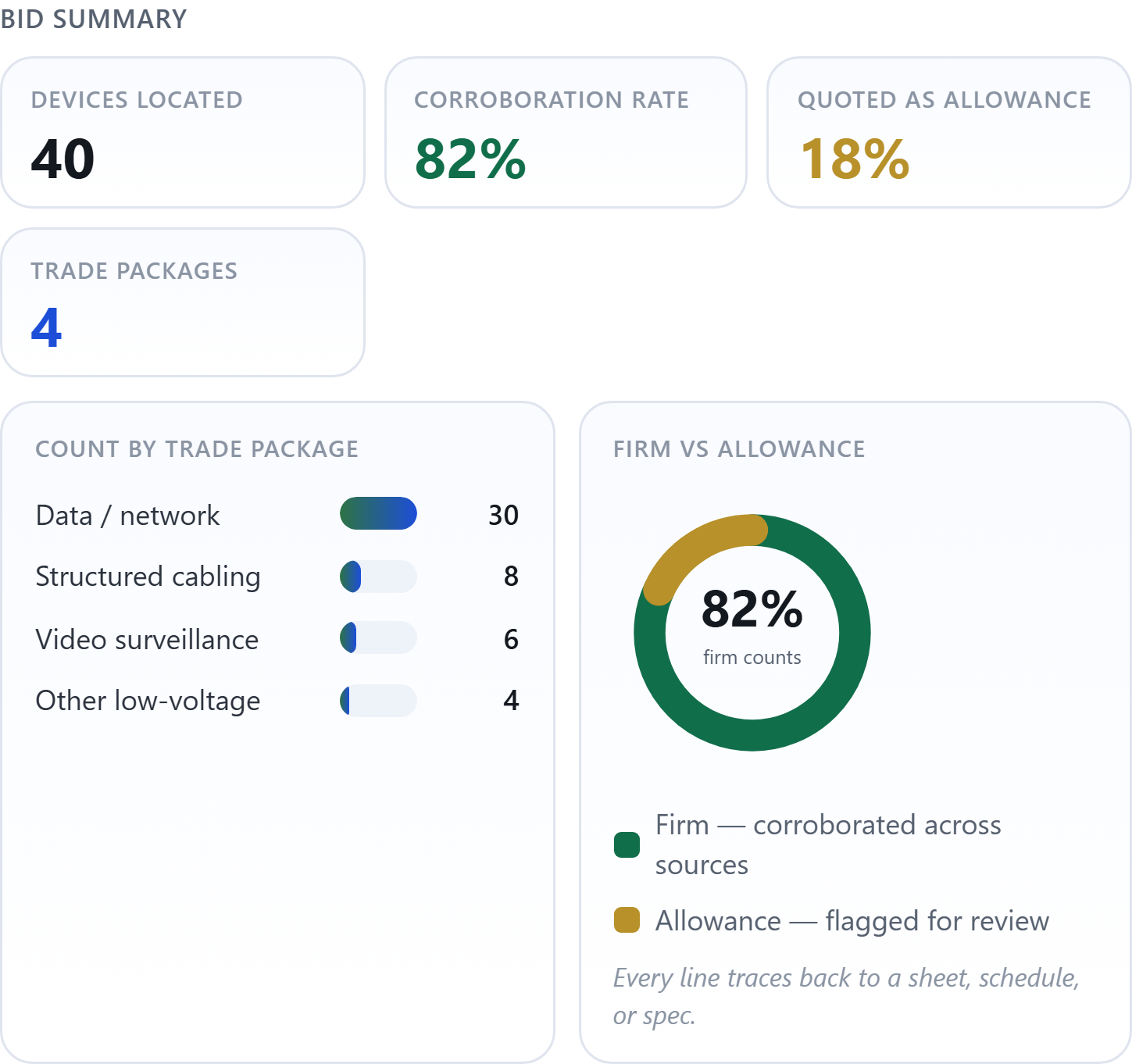
Not every count deserves the same confidence, so Majic Takeoff never pretends otherwise. Firm counts are the ones the sources agree on. Allowances are the honest unknowns, flagged and quoted so you can decide how to carry them — not smoothed over into a single number that hides its own soft spots.
Confidence across this package1,284 devices
Illustrative split. Real ratios vary by how complete a given set is.
Manual takeoff
A single human pass. One number at the bottom, and no fast way to show how it was reached or what it might have missed.Majic Takeoff
Corroborated counts with a source trail, unknowns flagged as allowances, and a clear firm-vs-allowance split you can defend.When docs are silent
Easy to leave a zero — or to quietly guess — and hope it holds.When docs are silent
Quoted as a marked allowance and surfaced, so nothing hides in the total.Inside a takeoff
What a finished takeoff looks like
The job detail your estimators open, shown here on an illustrative project with invented numbers. Every figure below is fictional — on a real job it's your data, with the source trail behind each count.
Six-story medical office and outpatient pavilion, roughly 180,000 SF over a two-level structured-parking podium. Low-voltage scope spans the full building: a telecom room on each floor, a rooftop equipment penthouse, and a central monitoring point at the ground-floor security desk.
Furnish and install the complete low-voltage systems package: structured cabling backbone and horizontal runs, network data outlets, wireless coverage, IP video surveillance, card access at controlled openings, overhead paging, and area intrusion. Devices are located and counted across the coordinated set; quantities the drawings and specifications leave open are carried as clearly-marked allowances rather than guessed.
| Count | Text | Vision | Cross-ref | Synthesis |
|---|---|---|---|---|
| Network data outlets | 408 | 405 | 412 | 412 |
| Wireless access points | 60 | 66 | 64 | 64 |
| Fixed cameras | 144 | 146 | 150 | 148 |
| Card readers | 92 | 95 | 96 | 96 |
| Ceiling speakers | 205 | 208 | 210 | 210 |
| Door contacts | 38 | 40 | — | 42 |
Illustrative example · fictional project and figures
What you get
Everything a bid needs, nothing that slows it down
Fast turnaround
Most packages come back the same day, so you can bid the jobs you'd otherwise skip for lack of time.
Line-item defensibility
Every count carries its source trail. Answer "where did this come from?" without flipping through a single sheet.
Combined + per-trade bids
One total and clean trade packages from the same takeoff — bid it whole or split it however the job is let.
Revision tracking
Feed in an addendum or revised set and see exactly what changed, so your number never lags the documents.
Firm vs allowance, made explicit
Solid counts and honest unknowns are labeled separately, so you decide how to carry the risk — nothing is hidden in the total.
Scope you can see
Every device located and accounted for — so a schedule on a sheet you'd have skimmed doesn't become the loss you find later.
Request a demo
See a real takeoff on your own drawings
Tell us a little about your work and we'll set up a walkthrough on a set you know cold — so you can judge the counts against your own eyes, not a canned example.
Already bid a job? Send us the priced plan set and compare our counts to yours: nmorris@greencommllc.com.
Prefer email? Reach us any time at nmorris@greencommllc.com.
Rather have it run for you?
AI coaching, training, development and consulting from the team that built this.
We run this software for our own company every day. We can set it up, connect it to your systems and support it for yours, with response times in writing.
Bid more. Defend every number.
Let Majic Takeoff carry the count so your estimators can carry the judgment. Request a demo and put it on a set you already know.